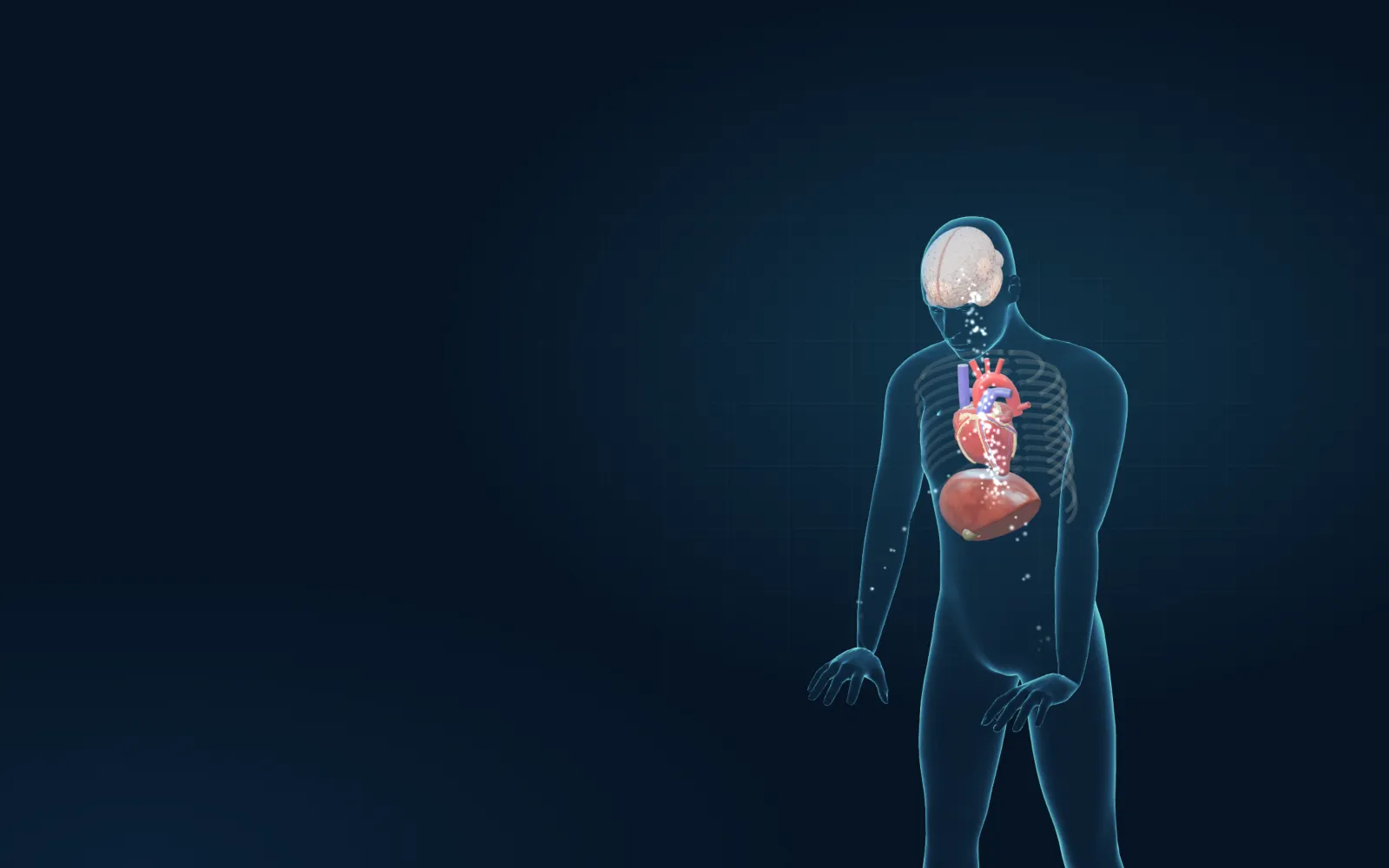
Hour 0 to 4
Digesting your last meal
Sugar from your meal pours into your blood, mostly as glucose. Insulin tells your liver and muscles to store it as glycogen, a reserve for later. The rest goes into your fat cells.
Your meal
 How You Tick Fasting
Coming soon
A fasting timer for iPhone
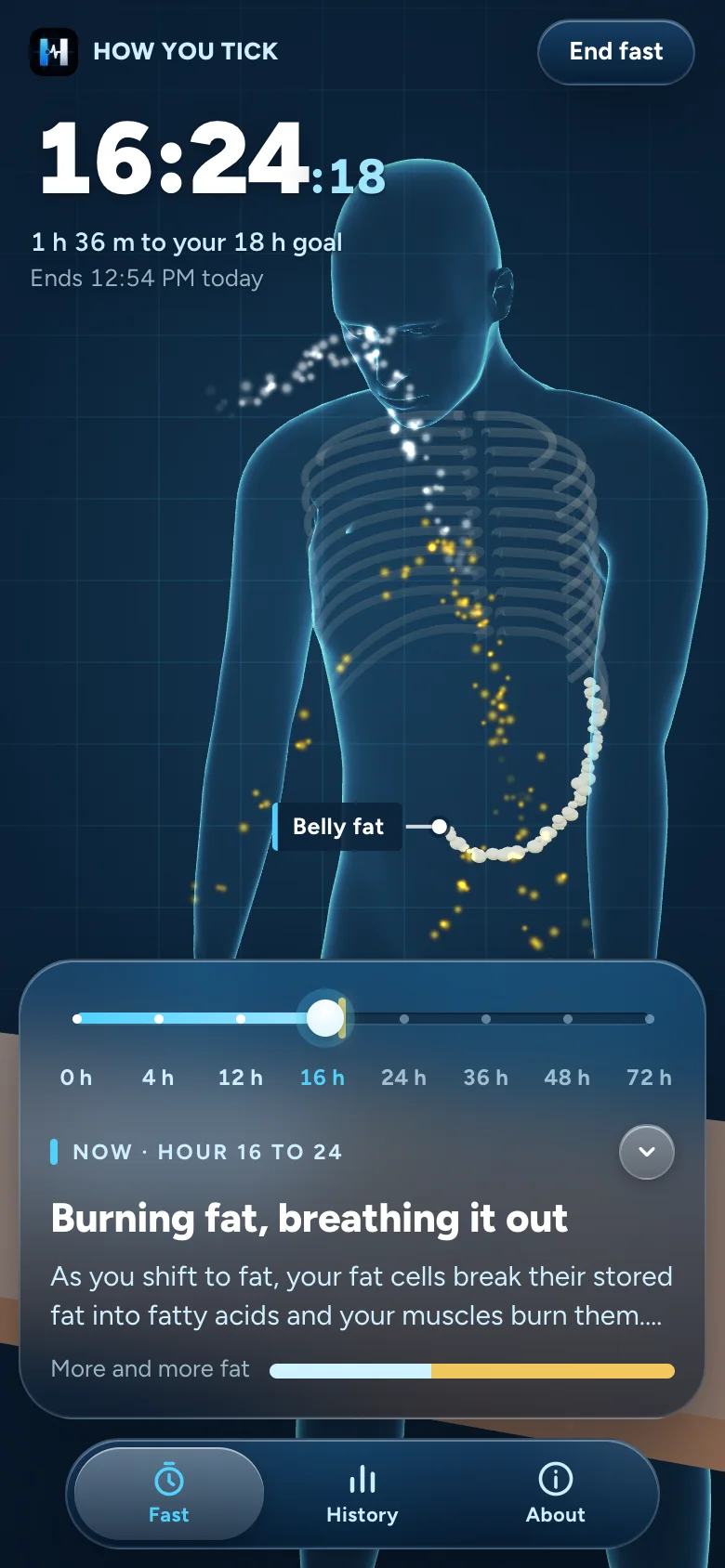
A timer built on a see-through 3D body. Hour by hour, it shows which fuel you’re running on and which organs are doing the work.
Hour by hour
Scroll through a fast. This is the same body that sits behind the timer in the app, showing only the organs at work.
Hour 0 to 4
Sugar from your meal pours into your blood, mostly as glucose. Insulin tells your liver and muscles to store it as glycogen, a reserve for later. The rest goes into your fat cells.
Hour 4 to 12
Your meal is stored and your blood sugar drifts down. Your pancreas sends out glucagon, telling your liver to turn glycogen back into glucose for your brain. In one study, about two thirds of that glucose was being built new from smaller molecules.
Hour 12 to 16
Somewhere between hour 12 and hour 36, your liver’s glycogen runs low and your main fuel shifts from glucose to fat. A fuller store pushes the switch later. Moving around brings it sooner.
Hour 16 to 24
As you shift to fat, your fat cells break their stored fat into fatty acids and your muscles burn them. The carbon leaves as carbon dioxide. About 84% of the weight of fat you burn, you breathe out.
Hour 24 to 36
In that 1991 study, after the first 22 hours about 82% of the glucose the liver sent out was newly made, not taken from its store. Hunger tends to come in waves around your usual mealtimes, and each wave passes on its own.
Hour 36 to 48
Fat pours out of your fat cells faster than your liver can burn it, so it turns the extra into ketones. They flow out to your heart, muscles and nerves as fuel. Some become acetone and leave on your breath.
If you have diabetes, ketones can build up until your blood turns acidic (diabetic ketoacidosis), which is dangerous. Talk to your doctor before fasting. American Diabetes Association
Anton et al., Obesity, 2018 (review)Hour 48 to 72
Your brain has run on glucose your whole life. Now more and more of its energy comes from ketones made from your fat. In patients who fasted for 5 to 6 weeks, ketones replaced glucose as the brain’s main fuel.
Hour 72
In the 1991 study, by the third day 96% of the liver’s glucose was newly made. Your metabolism hasn’t crashed: in 11 lean adults fasting 84 hours, resting energy use was about 14% higher on day 3.
After more than about 5 days with little or no food, eating again too fast can cause refeeding syndrome, which can stop the heart. Fasts this long need a doctor. NICE guideline CG32
Zauner et al., Am J Clin Nutr, 2000 (11 adults)The app
No rings, no badges, no feed. A timer, a body and the science behind each hour, on one screen.
Pick 12, 16 or 18 hours, or set your own from 8 to 72. Drag the timeline to see what any hour ahead looks like.
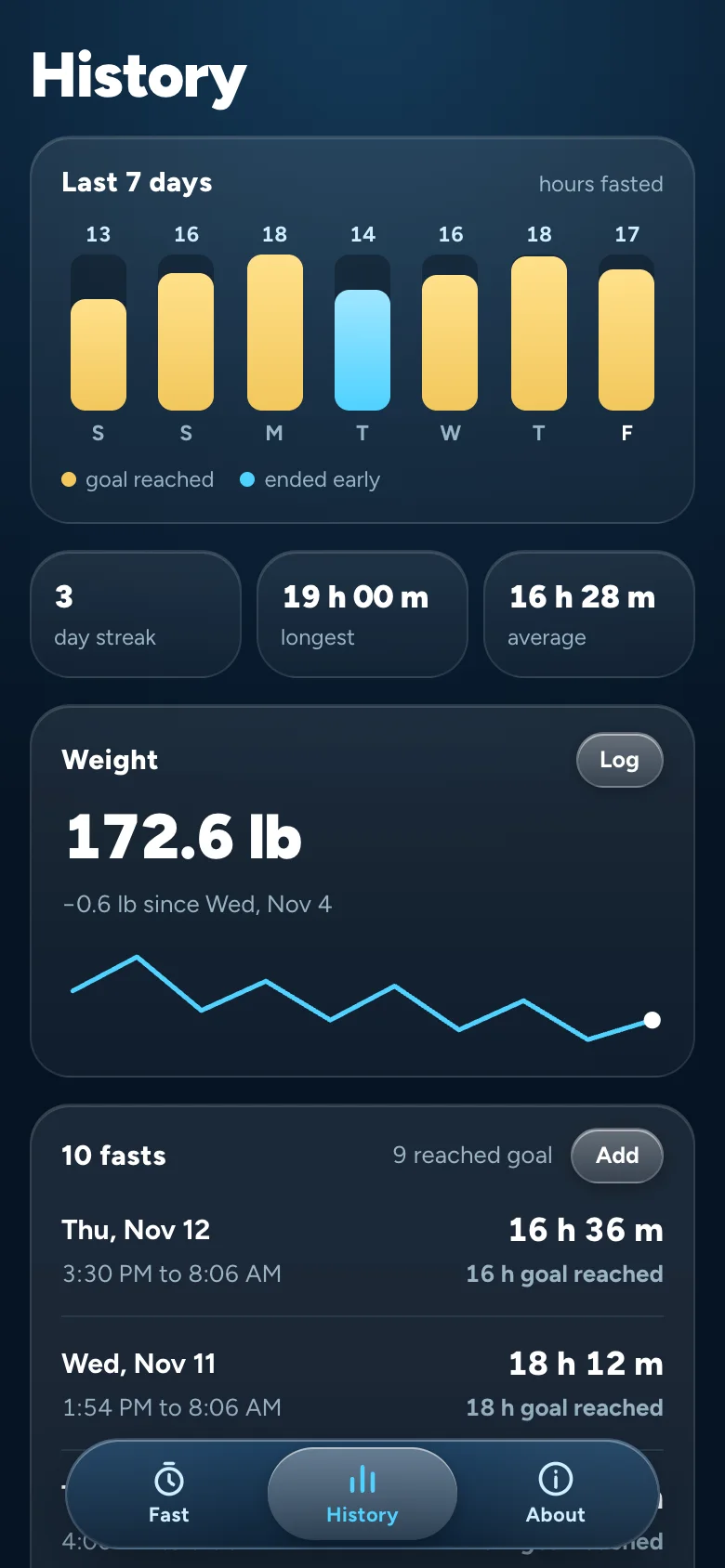
Your streak, your longest fast, the last seven days, and a weight log if you want one. Forgot to start the timer? Add the fast afterward.
No account. No sign-up. Your fasts and your weight never leave your device.
Each hour’s text links to the study behind it, and says how many people were in it.
Straight answers
Most fasting apps promise things the research doesn’t show. This one doesn’t.
Eating in an 8-hour window lost no more weight than eating through the day over 12 weeks, and no more than ordinary calorie cutting over a year.
Lowe et al., JAMA Intern Med, 2020 (116 adults) Liu et al., N Engl J Med, 2022 (139 adults)
In people, nobody has shown an hour when fasting switches on your cells’ clean-up.
It shows what typically happens in a healthy adult. The timing varies from person to person.
Don’t fast without talking to your doctor first if you:
Johns Hopkins Medicine Cleveland Clinic Harvard T.H. Chan School of Public Health
How You Tick Fasting is on its way to the App Store.